Texture Exporter/Reference
Warnings and size estimates
What each warning means and how to fix it, and how file sizes are estimated before export.
Textures that will cause problems are flagged before you export. The line above the texture list counts them, the row shows a warning icon, and Details says what’s wrong.
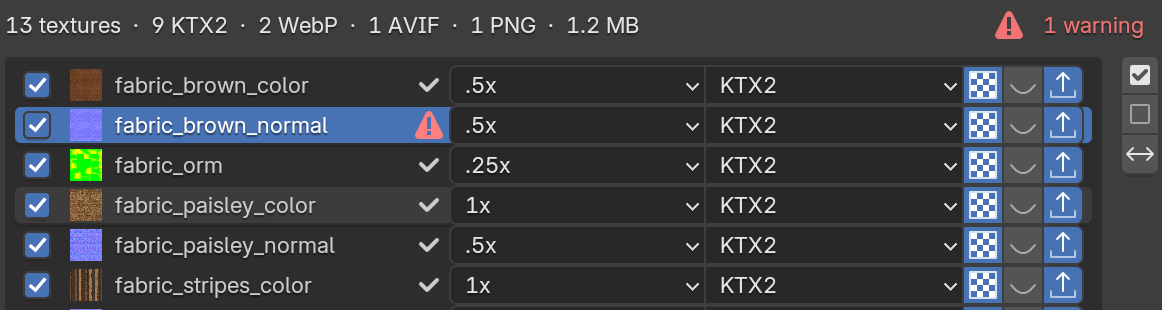
Warnings
| Warning | Why, and what to do |
|---|---|
| W×H isn’t a multiple of 4 | Basis Universal works in 4×4 blocks, so KTX2 is resized to the nearest multiple of 4, a slight stretch. Use a power-of-two or multiple-of-4 source, or another format. |
| over 4096 / over 8192 | Many mobile GPUs, and some WebGL setups, can’t load textures this large. Lower the Scale. |
| Normal map set to Colour | It would be stored as sRGB and shade wrong. Set Usage to Auto or Normal. |
| Normal map image uses sRGB in Blender | Set the image’s colour space to Non-Color in Blender. |
| ETC1S on a normal map | ETC1S makes shading on normals blocky. Use UASTC (Auto already does). |
| This Blender version can’t write AVIF | AVIF needs Blender 5.2. Pick another format. |
| Image file missing | Blender can’t find the image file (it shows as 0×0), and the row says file missing. Relink it with File ▸ External Data ▸ Find Missing Files. Until then the glTF export leaves that slot out (or just the missing channels of a packed texture), instead of the white placeholder Blender’s exporter would write. |
| Not saved | A ticked texture uses an image that was never saved to a file, or has unsaved edits. Exports still work from the pixels in memory, but the image is lost when Blender closes. Save it (Image ▸ Save As) or pack it in the Image Editor. Packed images don’t count. |
| Materials: … | glTF export window only: the exporter’s Materials option isn’t Export, so no textures end up in the glTF. Set Data ▸ Material ▸ Materials to Export. |
Size estimates
Before a texture is exported, Details shows an estimated file size and the GPU memory it will take. Once it’s exported, the real file size replaces the estimate.
- Estimates come from a bits-per-pixel model fitted on real textures, per format, codec and quality.
- Real sizes depend a lot on content: smooth gradients come out much smaller than estimated, and photos somewhat larger.
- GPU memory is what matters for how many textures a device can hold. KTX2 stays compressed on the GPU; WebP, AVIF and PNG are decoded to full size, whatever their file size.